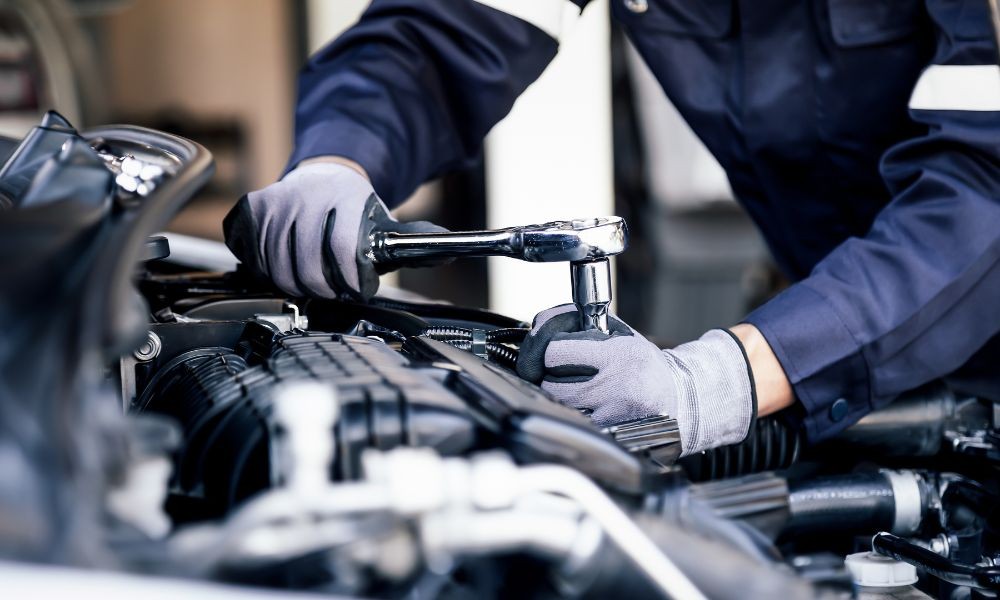
Stand at the roller door of a general workshop on a weekday morning and the trade explains itself. Each bay holds a different kind of trouble, and between them they cover nearly everything that goes wrong with an ordinary car. For anyone who finds car repair quotations hard to follow, a walk from the front of the floor to the back is a quicker education than any glossary, because the jobs are grouped the way mechanics think about them.
The Diagnostic Corner by the Door
Nearest the entrance sits a trolley with a scan tool and a laptop. Most visits now begin here. Plugged into the car, the tool reads fault codes stored by the engine, gearbox, brake and body computers. A code names a circuit or a system that has misbehaved, not the part to replace, so a good technician follows it with tests: live readings, a smoke test for air leaks, a look at wiring.
First Lift: Things That Stop the Car
The first lift is nearly always occupied by a car with its wheels off. Brake work is the bread and butter of the trade: pads worn to the indicator, discs scored or thinned below their minimum, a caliper whose sliding pins have seized, fluid overdue for renewal. Symptoms the owner reported might include squealing, a pulsing pedal, pulling to one side or a pedal that sinks.
Second Lift: Things That Hold It on the Road
Next door a car sits with a wheel hanging and a mechanic levering at a joint. Suspension and steering repairs deal with the links, bushes, ball joints, dampers and springs that keep each tyre flat on the road. Knocks over humps, a wandering feel on the expressway and tyres worn along one shoulder all lead here. Once worn parts are replaced, the wheels are aligned on a separate rig, since new components shift the geometry and misalignment eats tyres quickly.
The Raised Bonnet: Cooling and Leaks
A saloon with its bonnet raised and a pressure tester screwed to the radiator represents the cooling system. Hoses harden, plastic tanks crack, water pumps weep and thermostats stick, and in a hot climate any of these can send the gauge upward. The same bay handles oil leaks from rocker cover gaskets and seals. A workshop offering a full range of workshop repairs will pressure-test before replacing anything, because the visible drip is often downstream of the real leak.
The Cold Air Complaint
Further along, a machine with red and blue hoses is connected to a car’s air-conditioning ports. Weak cooling is a constant local complaint. Causes run from a blocked cabin filter and low refrigerant to a leaking condenser, a failing compressor or a faulty blend flap behind the dashboard. Proper practice is to recover the gas, hold a vacuum to check for leaks, then recharge by weight.
The Bench With the Multimeter
At a bench near the wall, someone is probing a connector with a multimeter. Electrical work covers the battery, alternator and starter motor, along with the sensors, switches and wiring that modern cars depend on. A slow crank, flickering lamps, windows that stop halfway or an intermittent warning light belong here. These faults take patience more than parts. Much of the bill is time spent tracing a circuit, which is why an hourly diagnostic rate is normal and fair.
The Tall Lift at the Rear
On the tall lift at the rear a car is raised to head height with its gearbox supported on a jack. This is driveline territory: clutches on manual cars, driveshafts and their rubber boots, wheel bearings that drone, and the engine and gearbox mounts that absorb vibration. Jobs here are labour-heavy because so much has to be removed to reach the worn item.
The Engine on a Stand
In the corner stands an engine on a stand with its cylinder head on the bench beside it. Major engine work is the least common job on the floor but the most expensive: a blown head gasket, a stretched timing chain or overdue timing belt, worn piston rings burning oil. Before agreeing to anything here, expect compression or leak-down test results and a clear explanation of what was found. For an older car, this is also where repair has to be weighed against the vehicle’s remaining life.
Behind the Glass: How Work Becomes a Quotation
Behind a glass partition the service adviser turns all of this into numbers. A proper quotation separates parts from labour, states whether parts are original, equivalent from the same factories, or aftermarket, and gives labour as hours at a stated rate. It should say how long the work is guaranteed and whether the old parts will be returned. If two quotations for the same fault differ widely, the gap is nearly always in parts grade or in what each has assumed, so ask.
Using the Tour When Your Own Car Is on the Lift
When your own car is the one on the lift, place the problem on this floor plan. Ask which system is at fault, what test proved it, and whether the item is a safety matter, a breakdown risk or a comfort issue. Approve the first without delay, schedule the second, and budget for the third. Keep every invoice with the mileage noted. Handled this way, car repair stops being an unwelcome surprise and becomes a set of ordinary decisions made with the facts in front of you.